
Trump Accounts: Complete Guide to the New Tax-Advantaged Savings Accounts for Children (2026)
Trump Accounts are tax-advantaged IRAs for children under 18 created by the One Big Beautiful Bill Act. $1,000 government deposit for births 2025–2028. $5,000/year contribution limit. Contributions begin July 4, 2026.
Quick Answer
A Trump Account is a tax-advantaged individual retirement account for children under age 18, created under IRC Section 530A as part of the One Big Beautiful Bill Act (2025). Eligible children born between 2025 and 2028 may receive a $1,000 federal pilot contribution. The account allows up to $5,000 in annual contributions, does not require earned income, and converts into a traditional IRA at age 18.
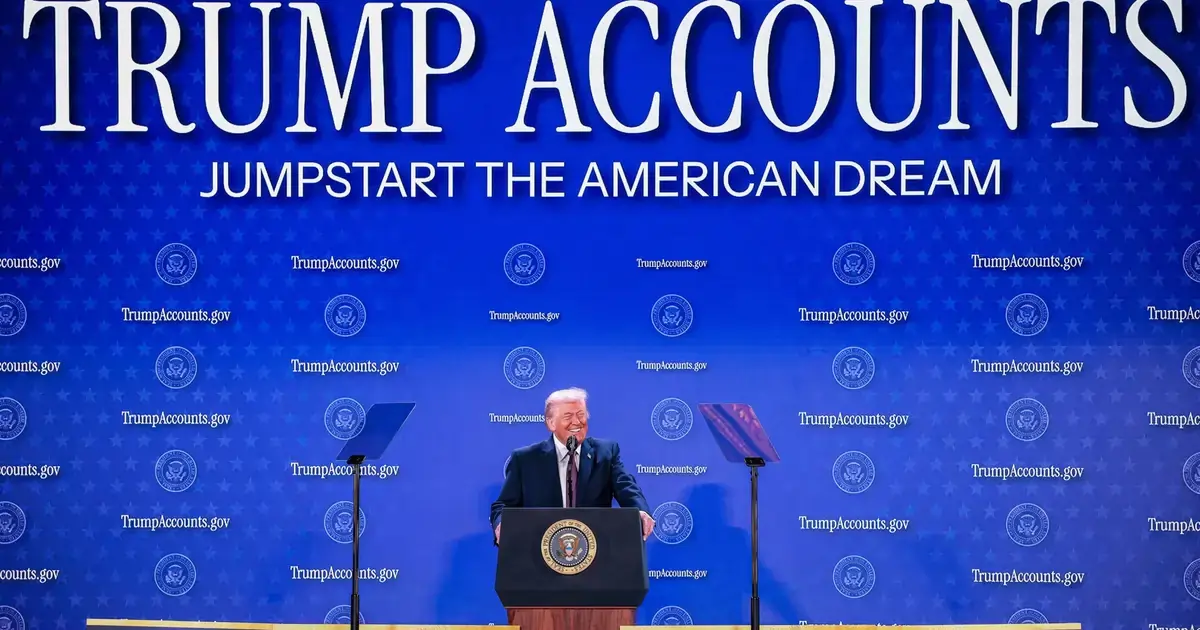
Trump Accounts — Key Facts
| Trump Accounts — Key Facts | |
|---|---|
| Detail | Information |
| Law | One Big Beautiful Bill Act (P.L. 119-21), Section 70204 (IRC Section 530A) |
| Signed into law | July 4, 2025 |
| Account type | Tax-advantaged individual retirement account (IRA) for children under 18 |
| Pilot program contribution | $1,000 one-time federal deposit for children born January 1, 2025 – December 31, 2028 |
| Pilot program eligibility | U.S. citizens with valid Social Security number, born 2025–2028 |
| Annual contribution limit | $5,000 per child (indexed to inflation beginning after 2027) |
| Employer contributions | Up to $2,500/year per employee's child (counts toward $5,000 limit) |
| Earned income required | No — contributions permitted regardless of child's or parent's income |
| Income limits | None — no MAGI phaseout for contributions |
| Contributions begin | July 4, 2026 |
| Eligible investments | Low-cost index mutual funds or ETFs tracking U.S. equities (max 0.10% annual fees) |
| Withdrawals before age 18 | Prohibited during the growth period (limited exceptions) |
| After age 18 | Account converts to traditional IRA; standard IRA rules apply |
| IRS Form | Form 4547, Trump Account Election(s) |
| Official website | irs.gov — Trump Accounts |
| Sources |
IRS — Trump Accounts
IRS Notice 2025-68 IRS — Instructions for Form 4547 |
Observed Advantages and Limitations
Observed Advantages:
- $1,000 federal pilot contribution for eligible births (2025–2028)
- No earned income requirement for contributions
- Annual contribution limit of $5,000 per child
- Employer contributions permitted (subject to program structure)
- Tax-deferred growth during accumulation period
Observed Limitations:
- Distributions generally prohibited before age 18 (limited statutory exceptions)
- Withdrawals subject to ordinary income taxation on earnings and pre-tax contributions
- Investment restrictions (primarily low-cost index funds during growth phase)
- Likely classification as a student asset for financial aid purposes (subject to FAFSA rules)
- No transferability to another beneficiary
What Is a Trump Accounts?
A Trump Account is a new type of tax-advantaged individual retirement account (IRA) created for children under 18 years old under the One Big Beautiful Bill Act (OBBBA), signed into law on July 4, 2025. Established under Internal Revenue Code Section 530A, Trump Accounts function as a specialized form of traditional IRA with rules unique to minor-age beneficiaries during a designated “growth period” that lasts until the calendar year in which the child turns 18.
The Working Families Tax Cuts provisions of the OBBBA authorized the creation of Trump Accounts to expand access to tax-advantaged savings for American families. Under the law, the child is the account owner (referred to as the “account beneficiary”), while a parent, legal guardian, adult sibling, or grandparent serves as the custodial “responsible party” who manages the account until the child reaches legal capacity.
The most notable feature of the program is a one-time $1,000 pilot program contribution from the U.S. Treasury Department for every eligible child born between January 1, 2025, and December 31, 2028, who is a U.S. citizen with a valid Social Security number. This federal deposit is invested automatically in an index fund and does not count toward the annual private contribution limit.
According to the IRS, Trump Accounts apply to taxable years beginning after December 31, 2025, and contributions cannot be made before July 4, 2026. The account is established by filing IRS Form 4547 (Trump Account Election) or through the online portal at trumpaccounts.gov.
Sources: IRS — Trump Accounts | IRS Notice 2025-68 (PDF) | IRS — Proposed Regulations on Trump Accounts
Who Is Eligible for a Trump Accounts?
Any child who has not turned age 18 before the end of the calendar year in which the election is made and who has a valid Social Security number is eligible for a Trump Account. There are no income requirements for the child or the parent, and no earned income is necessary to make contributions — a critical distinction from traditional and Roth IRAs.
Eligibility for the $1,000 Pilot Program Contribution
The $1,000 federal pilot program contribution has narrower eligibility requirements than the account itself. To receive the one-time $1,000 government deposit, a child must meet all of the following conditions:
The child must be born after December 31, 2024, and before January 1, 2029. The child must be a U.S. citizen. The child must have a valid Social Security number issued before the date of the election. The child must be anticipated to be the “qualifying child” of the authorized individual making the election for federal tax purposes in the year the election is made. No prior pilot program contribution election may have been processed for the child.
Children born before 2025 are eligible for a Trump Account but are not eligible for the $1,000 government contribution. Parents of children born before 2025 can still open Trump Accounts and make private contributions of up to $5,000 per year.
Who Can Open a Trump Account
An “authorized individual” must elect to open the initial Trump Account on behalf of the child. The IRS defines authorized individuals in the following priority order: legal guardian, parent, adult sibling, or grandparent of the child. If an election for the pilot program contribution is also being made, the authorized individual must be the individual eligible to make that election — typically the parent who anticipates the child will be their qualifying child for the tax year.
Sources: IRS — Instructions for Form 4547 | IRS — Treasury, IRS Issue Guidance on Trump Accounts | IRS — About Form 4547
How to Open a Trump Accounts
Opening a Trump Account requires filing IRS Form 4547, Trump Account Election(s). Form 4547 serves two purposes: electing to open the initial Trump Account and, if applicable, requesting the $1,000 pilot program contribution from the U.S. Treasury.
Filing Methods
Electronic filing is the method the IRS identifies as the fastest, safest, and easiest option. Form 4547 can be e-filed with the authorized individual’s current-year federal income tax return (Form 1040). Most tax software packages include Form 4547 as an option during the filing process.
Paper filing is also accepted. Paper Form 4547 must be mailed to the IRS address listed at IRS.gov/PaperReturns for the applicable tax year.
Online portal at trumpaccounts.gov is expected to become available for making elections beginning in mid-2026, providing an alternative to filing Form 4547 with a tax return.
Filing Timeline
Form 4547 can be filed at any time, including with the 2025 income tax return. The IRS recommends filing Form 4547 with the 2025 tax return to ensure the account is established and available when contributions begin on July 4, 2026. For qualifying events occurring after the tax return has already been filed (such as the birth of an eligible child), the election can be made through the online portal once available.
What Happens After Filing
After the election is made on Form 4547, the Treasury Department (or its agent) will send information to the authorized individual beginning in May 2026 to authenticate and complete the account opening process. The individual who makes the election becomes the “responsible party” of the Trump Account, with authority to select among eligible investments, request qualified rollover contributions, and designate a successor responsible party.
Sources: IRS — Instructions for Form 4547 | IRS — Proposed Regulations on Trump Accounts | trumpaccounts.gov
Contribution Rules
Trump Accounts accept contributions from multiple sources, each subject to different limits and tax treatment. No contributions of any kind are permitted before July 4, 2026.
Annual Contribution Limit
The aggregate annual contribution limit from individuals and employers is $5,000 per child for 2026 and 2027. Beginning after 2027, the $5,000 limit is subject to cost-of-living adjustments indexed to inflation. No earned income is required from the child or the contributing individual to make contributions.
Who Can Contribute
Individuals: Children (the account beneficiaries themselves), parents, guardians, grandparents, family members, friends, and any other person can contribute to a Trump Account. Individual contributions are made on an after-tax basis and create basis in the account.
Employers: An employer may contribute up to $2,500 per year to the Trump Account of an employee or an employee’s dependent under a qualifying Trump Account contribution program established pursuant to IRC Section 128. Employer contributions count toward the $5,000 annual limit but are excluded from the employee’s taxable income and are deductible by the employer as a fringe benefit. The $2,500 employer limit is indexed to inflation beginning after 2027.
Government entities and charitable organizations: Federal, state, local, and tribal government entities and IRC Section 501(c)(3) charitable organizations may make “qualified general contributions” to Trump Accounts for children in a “qualified class” (such as all children born in a particular year, all children in a state, or all children nationwide). Qualified general contributions do not count toward the $5,000 annual limit and do not create basis in the account.
Pilot program contribution: The one-time $1,000 federal deposit does not count toward the $5,000 annual limit and does not create basis in the account.
Tax Treatment of Contributions
Contributions to a Trump Account during the growth period are not included in the child’s income when made. However, the tax treatment at withdrawal differs by contribution source. Contributions made by individuals (after-tax contributions) create basis in the account — meaning those dollars can later be withdrawn without additional income tax. Pilot program contributions, qualified general contributions, and employer contributions do not create basis, meaning the full amount of these contributions plus any earnings is taxable upon distribution.
Sources: IRS — Treasury, IRS Issue Guidance on Trump Accounts | IRS Notice 2025-68 (PDF) | IRS — Instructions for Form 4547
Eligible Investments During the Growth Period
During the growth period (before January 1 of the calendar year in which the child turns 18), funds in a Trump Account are restricted to “eligible investments” as defined by IRC Section 530A and IRS guidance.
An eligible investment is a mutual fund or exchange-traded fund (ETF) that meets all of the following criteria: the fund tracks a qualified index of primarily U.S.-based companies (such as the Standard & Poor’s 500 stock market index), the fund does not use leverage, the fund’s annual fees and expenses do not exceed 0.10% (10 basis points) of the balance, and the fund meets any other criteria determined by the Secretary of the Treasury.
Money market funds and cash holdings are generally not permitted as eligible investments during the growth period, with limited exceptions for cash. Funds in a Trump Account may be invested across more than one eligible investment — the law does not require all funds to be held in a single fund.
The Trump Account trustee is required to have procedures in place to monitor whether funds held in the account continue to meet the eligible investment criteria. If a fund ceases to qualify (for example, if its fees increase above the 0.10% threshold or if the index it tracks ceases to be a qualified index), the trustee’s procedures must require reasonable ongoing monitoring and corrective action.
After the growth period ends, the eligible investment restrictions no longer apply and the account is subject to standard traditional IRA investment rules.
Sources: IRS Notice 2025-68 (PDF) | IRS — Treasury, IRS Issue Guidance on Trump Accounts
Withdrawals and Distribution Rules
No withdrawals are permitted from a Trump Account during the growth period, except in the following limited circumstances: qualified rollover contributions to another Trump Account, qualified ABLE rollover contributions (a trustee-to-trustee transfer of the entire balance to an ABLE account during the calendar year in which the beneficiary turns 17), distributions of excess contributions, and distributions upon the death of the account beneficiary.
After the Growth Period (Age 18+)
Beginning January 1 of the calendar year in which the child turns 18, the Trump Account is treated as a traditional IRA and is generally subject to the same distribution rules that apply to other traditional IRAs. This means:
Distributions of after-tax contributions (basis) are not subject to additional income tax, since taxes were already paid on these amounts when contributed.
Distributions of pre-tax amounts — including pilot program contributions, qualified general contributions, employer contributions, and all investment earnings — are taxed at the beneficiary’s ordinary income tax rate.
Early distribution penalty: Withdrawals taken before the beneficiary reaches age 59½ may be subject to a 10% additional tax under IRC Section 72(t), unless an exception applies. IRA exceptions that may apply to Trump Account distributions include qualified higher education expenses and first-time home purchases (up to $10,000 lifetime).
Roth conversion: After the growth period, the Trump Account can be converted to a Roth IRA. Any pre-tax amounts converted are taxable at the beneficiary’s ordinary income tax rate in the year of conversion. After conversion, future growth accumulates tax-free and qualified withdrawals after age 59½ are tax-free.
Required minimum distributions (RMDs): After the growth period, Trump Accounts are subject to the same RMD rules that apply to traditional IRAs.
Separation From Other IRAs
If a beneficiary keeps the Trump Account separate from other traditional IRAs after turning 18, the Trump Account is not combined with other IRAs when calculating taxes and penalties on withdrawals. This separation can provide beneficial financial planning flexibility in determining which account type to use for withdrawals or Roth conversions.
Sources: IRS Notice 2025-68 (PDF) | IRS — Instructions for Form 4547
Trump Accounts vs. Other Child Savings Accounts
The following comparison table shows how Trump Accounts differ from other tax-advantaged savings options available for children.
| Feature | Trump Account | 529 Plan | Custodial Roth IRA | UGMA/UTMA Custodial Account |
|---|---|---|---|---|
| Created by | OBBBA (2025), IRC §530A | IRC §529 (1996) | IRC §408A | State UGMA/UTMA laws |
| Account type | Traditional IRA for minors | Education savings plan | Roth IRA held by custodian | Taxable brokerage account |
| Government seed money | $1,000 for births 2025–2028 | None | None | None |
| Earned income required | No | No | Yes — child must have earned income | No |
| Income limits for contributors | None | None | MAGI limits apply | None |
| Annual contribution limit | $5,000 per child | No annual limit (gift tax rules apply; lifetime limits vary by state) | $7,000 (2025) or earned income, whichever is less | No limit (gift tax rules apply) |
| Employer contributions | Up to $2,500/year (tax-free to employee) | Not applicable | Not applicable | Not applicable |
| Tax treatment of contributions | After-tax (individuals); pre-tax (employer, govt, charity) | After-tax (some states offer deduction) | After-tax | After-tax |
| Tax treatment of growth | Tax-deferred | Tax-deferred | Tax-free | Taxable annually (kiddie tax may apply) |
| Tax treatment of withdrawals | Ordinary income tax on earnings and pre-tax contributions | Tax-free for qualified education expenses | Tax-free after age 59½ | Taxable (capital gains rates) |
| Withdrawals before 18 | Prohibited (limited exceptions) | Permitted for qualified education expenses | Contributions withdrawable anytime; earnings subject to penalty | Permitted for child's benefit |
| Primary purpose | Long-term wealth building / retirement | Education expenses | Retirement (flexible) | General savings for child |
| Investment options | U.S. equity index funds/ETFs only | Multiple options (varies by state) | Broad investment menu | Broad investment menu |
| Transferable to another child | No | Yes — to eligible family member | No | No |
| Financial aid impact | Likely student asset (assessed at 20%) | Parent asset if parent-owned (assessed at 5.64%) | Student asset (20%) | Student asset (20%) |
| After age 18 | Converts to traditional IRA | Remains 529; Roth rollover up to $35,000 lifetime | Remains Roth IRA | Full control transfers to child |
| Sources |
IRS — Trump Accounts IRS — 529 Plans IRS — Roth IRAs IRS — Form 4547 |
|||
Typical Use Cases (Observed)
Typical Use Cases (Observed):
- Long-term savings structures established for minors under IRC Section 530A
- Accounts receiving federal pilot contributions tied to birth eligibility windows (2025–2028)
- Employer-sponsored contributions structured under applicable tax provisions
- Situations where earned income requirements prevent the use of Roth IRA accounts for minors
Comparison Context (Commonly Referenced Structures):
- Education-focused savings plans (IRC Section 529)
- Custodial Roth IRA accounts (earned income required)
- UGMA/UTMA custodial brokerage accounts
Structural Comparison by Use Case
| Structural Comparison by Use Case | |
|---|---|
| Scenario | Common Structure Used |
| Education-focused savings | 529 Plan (IRC Section 529) |
| Long-term retirement savings (minor) | Trump Account (IRC Section 530A) |
| Earned income-based contributions | Roth IRA (IRC Section 408A) |
| Flexible custodial savings | UGMA/UTMA custodial account (state law) |
Illustrative Example (Compounding Effect)
Illustrative Example:
A child born in 2025 receives a $1,000 federal pilot contribution.
Annual contributions of $5,000 are made over an 18-year period.
Assuming a 7% annual return, the account value at age 18 may exceed $170,000 depending on contribution timing and market performance.
This example illustrates the potential impact of long-term compounding within a tax-deferred structure under IRC Section 530A.
Regulatory Classification
Regulatory Classification:
Trump Accounts are treated as individual retirement arrangements under the Internal Revenue Code (IRC Section 530A). Contribution rules, taxation of distributions, and rollover treatment are governed by federal tax law and IRS guidance, including Notice 2025-68 and Form 4547 instructions.
Key Differences from Traditional IRA Structures
Key Differences from Traditional IRA Structures:
- No earned income requirement for contributions
- Federal pilot contribution available for eligible birth cohorts
- Contribution limits differ from standard IRA limits
- Account automatically converts to a traditional IRA at age 18
Trump Accounts and IRA Coordination
Trump Account contributions during the growth period do not affect how much a child (or anyone else) can contribute to other IRAs. A teenager with earned income may contribute to both a Trump Account and a traditional or Roth IRA in the same year without one reducing the contribution limit of the other. The $5,000 Trump Account annual limit is entirely separate from the standard IRA annual contribution limit ($7,000 for 2025).
After the growth period, the Trump Account becomes subject to most standard traditional IRA rules. However, an account initially established as a Trump Account can never receive contributions under a SEP arrangement (IRC Section 408(k)) or a SIMPLE IRA plan (IRC Section 408(p)).
The Trump Account trustee may include a provision in the governing instrument allowing automatic transfer of all assets to a standard traditional IRA for the same beneficiary at the same trustee immediately after the growth period ends.
Sources: IRS Notice 2025-68 (PDF) | IRS — Instructions for Form 4547
Employer Trump Accounts Contribution Programs
Employers may establish a Trump Account contribution program under IRC Section 128 to contribute to the Trump Accounts of employees or their dependents. Employer contributions under a qualifying program are excluded from the employee’s taxable income and are deductible by the employer.
The annual limit for employer contributions is $2,500 per employee per child for 2026, subject to cost-of-living adjustments beginning after 2027. Employer contributions count toward the $5,000 aggregate annual contribution limit — they do not create a separate additional limit.
A qualifying Trump Account contribution program must meet requirements similar to those that apply to dependent care assistance programs under IRC Section 129, including nondiscrimination rules related to eligibility, notification, and benefit levels. Employers offering Trump Account contribution programs are required to provide statements to employees.
Sources: IRS — Treasury, IRS Issue Guidance on Trump Accounts | IRS Notice 2025-68 (PDF)
Key Deadlines and Timeline
| Key Deadlines and Timeline | |
|---|---|
| Date | Event |
| July 4, 2025 | One Big Beautiful Bill Act signed into law; Trump Accounts created under IRC Section 530A |
| December 2, 2025 | IRS issues Notice 2025-68 with initial guidance on Trump Accounts |
| January 8, 2026 | IRS posts Form 4547, Trump Account Election(s) |
| Tax filing season 2026 | Form 4547 can be filed with 2025 income tax returns |
| May 2026 | Treasury begins sending account activation information to authorized individuals |
| Mid-2026 | Online portal at trumpaccounts.gov expected to launch for electronic elections |
| July 4, 2026 | First date contributions can be accepted into Trump Accounts |
| After 2027 | $5,000 annual contribution limit and $2,500 employer limit begin adjusting for inflation |
| December 31, 2028 | Last date of birth eligible for the $1,000 pilot program contribution |
| Sources |
IRS — Trump Accounts
IRS — Instructions for Form 4547 IRS — Notice 2025-68 Guidance |
Frequently Asked Questions
What is a Trump Accounts?
A Trump Accounts is a tax-advantaged individual retirement account (IRA) for children under 18, created by the One Big Beautiful Bill Act (P.L. 119-21) under IRC Section 530A. The account is owned by the child and managed by a parent, guardian, or other authorized individual until the child reaches age 18. Contributions grow tax-deferred, and funds are invested in low-cost U.S. equity index funds during the growth period. After the child turns 18, the account is treated as a traditional IRA.
How do I open a Trump Accounts for my child?
An authorized individual (legal guardian, parent, adult sibling, or grandparent) must file IRS Form 4547 to elect to open a Trump Accounts. Form 4547 can be filed electronically with a federal income tax return, on paper, or through the online portal at trumpaccounts.gov (expected mid-2026). The IRS recommends filing Form 4547 with the 2025 tax return so the account is ready when contributions begin on July 4, 2026.
Who qualifies for the $1,000 government contribution?
Children born between January 1, 2025, and December 31, 2028, who are U.S. citizens with a valid Social Security number, are eligible for the one-time $1,000 pilot program contribution from the U.S. Treasury. The authorized individual must check the box on Line 7 of Form 4547 to request the contribution. Children born before 2025 or who are not U.S. citizens are eligible for Trump Accounts but do not qualify for the $1,000 government deposit.
Can I open a Trump Account for an older child?
Yes. Any child who has not turned 18 before the end of the calendar year in which the election is made and has a valid Social Security number is eligible for a Trump Account. However, children born before 2025 are not eligible for the $1,000 pilot program contribution from the federal government.
How much can I contribute to a Trump Account each year?
The aggregate annual contribution limit from individuals and employers is $5,000 per child for 2026 and 2027, with cost-of-living adjustments beginning after 2027. The $1,000 government pilot program contribution and qualified general contributions from government entities and charities do not count toward this limit.
Does my child need earned income to have a Trump Account?
No. Unlike traditional and Roth IRAs, Trump Accounts do not require the child to have earned income. Contributions can be made regardless of whether the child has any compensation.
Are there income limits for parents contributing to a Trump Account?
No. There are no modified adjusted gross income (MAGI) limits restricting who can contribute to a Trump Account. Any individual can contribute, regardless of income level.
When can I start contributing to a Trump Account?
Contributions to Trump Accounts cannot be made before July 4, 2026. The election to open the account (Form 4547) can be filed at any time, but no money can be deposited until the July 2026 start date.
What can Trump Account funds be invested in?
During the growth period (before the child turns 18), Trump Account funds are restricted to eligible investments: low-cost index mutual funds or exchange-traded funds (ETFs) that track a qualified index of primarily U.S.-based companies, do not use leverage, and have annual fees and expenses of no more than 0.10% (10 basis points). After the child turns 18, standard IRA investment rules apply.
Can I withdraw money from my child’s Trump Account before they turn 18?
No. During the growth period, no distributions are permitted except for qualified rollover contributions to another Trump Account, qualified ABLE rollover contributions (during the year the child turns 17), distributions of excess contributions, and distributions upon the death of the account beneficiary.
What happens to a Trump Account when my child turns 18?
Beginning January 1 of the calendar year in which the child turns 18, the Trump Account is treated as a traditional IRA. The child assumes full control of the account. Standard IRA rules apply to contributions, distributions, rollovers, Roth conversions, and required minimum distributions. Withdrawals of after-tax contributions are tax-free, while pre-tax contributions and earnings are taxed as ordinary income.
Are Trump Account withdrawals tax-free?
No. Trump Accounts are tax-deferred, not tax-free. After age 18, withdrawals of pre-tax contributions (pilot program, employer, and charity contributions) and all earnings are taxed at the beneficiary’s ordinary income tax rate. Withdrawals of after-tax contributions (individual contributions that created basis) are not taxed again. Withdrawals before age 59½ may also be subject to a 10% early distribution penalty unless an IRA exception applies.
Can I transfer a Trump Account to another child?
No. A Trump Account is established for the exclusive benefit of a specific child. The account cannot be transferred to a different child. However, a qualified rollover contribution can be made to move the balance from one Trump Account to a “rollover Trump Account” for the same child at a different trustee.
Does a Trump Account affect financial aid eligibility?
The IRS has not issued specific guidance on how Trump Accounts interact with the FAFSA. Because the child is the account owner, Trump Accounts are likely to be classified as student assets on the FAFSA, assessed at a rate of up to 20% — similar to UGMA/UTMA custodial accounts. By contrast, parent-owned 529 plans are assessed at a lower rate of 5.64%.
Can my employer contribute to my child’s Trump Account?
Yes. Employers can contribute up to $2,500 per year to the Trump Account of an employee or an employee’s dependent under a qualifying Trump Account contribution program (IRC Section 128). The employer contribution is excluded from the employee’s taxable income and is deductible by the employer. The employer contribution counts toward the $5,000 aggregate annual limit.
Does contributing to a Trump Account reduce how much I can put in my child’s other IRA?
No. Trump Account contributions during the growth period are entirely separate from the annual contribution limits for traditional and Roth IRAs. A teenager with earned income can contribute to both a Trump Account ($5,000 maximum) and a Roth IRA ($7,000 maximum for 2025) in the same year.
Official Government Sources
All information on this page is compiled exclusively from official U.S. government (.gov) sources:
- IRS — Trump Accounts
- IRS — Treasury, IRS Issue Guidance on Trump Accounts (Notice 2025-68)
- IRS — Proposed Regulations on How to Open Trump Accounts
- IRS — Instructions for Form 4547 (Rev. 12-2025)
- IRS — About Form 4547, Trump Account Election(s)
- IRS Notice 2025-68 (PDF)
- IRS — One Big Beautiful Bill Guidance
- trumpaccounts.gov — Official Trump Accounts Portal
- U.S. Treasury — Trump Accounts Press Release (SB-0372)
- White House — Landmark Dell Gift Supercharges Trump Accounts
Update History
March 2026: Initial publication. All URLs verified functional.